

 Feed back
 Privacy Policy
Astrology Birth Chart & Horoscope Readings-20251218102621
The Vedic astrology birth chart, also known as the Janam Kundali, is a foundational tool in Vedic astrology used to map the positions of celestial bodies at the exact moment of an individual's birth. This astronomical snapshot serves as a cosmic blueprint, offering deep insights into personality traits, life events, karmic patterns, and future potentials. Rooted in ancient Indian wisdom, the Vedic astrology birth chart differs significantly from its Western counterpart by using the sidereal zodiac, which accounts for the Earth’s axial precession, resulting in more astronomically accurate planetary placements.
Unlike Western astrology, which primarily focuses on the Sun sign, Vedic astrology emphasizes the Moon sign (Rashi) and the Ascendant (Lagna), providing a more nuanced understanding of emotional temperament and physical constitution. The Vedic system also incorporates predictive techniques such as Dashas—planetary periods that govern different phases of life—and Gochara (transits), enabling practitioners to forecast significant life events with remarkable precision. Readers will learn how planetary positions across the 12 houses influence various aspects of life, including career, relationships, health, and spirituality, forming a holistic framework grounded in observable cosmic laws.

Vedic astrology, or Jyotish, originates from the ancient Indian scriptures known as the Vedas—particularly the Rigveda, Yajurveda, and Atharvaveda—which date back over 3,000 years. These texts describe celestial observations and their correlation with human affairs, establishing a system based on karma (action and consequence), dharma (duty or purpose), and the influence of cosmic energies on earthly existence. Unlike modern astronomy, which separates science from metaphysics, Vedic astrology integrates both, viewing planetary movements not as random occurrences but as reflections of universal order and karmic cycles.
Key principles such as the law of karma suggest that one’s current life circumstances are shaped by past actions, while planetary positions in the Vedic astrology birth chart indicate where these karmic imprints manifest. Dharma, on the other hand, guides individuals toward fulfilling their life purpose through alignment with natural rhythms. Over centuries, this knowledge was preserved orally by sages and scholars before being codified in classical texts like the *Brihat Parashara Hora Shastra*, attributed to Sage Parashara, who systematized the rules of chart interpretation, planetary significations, and predictive methods.
With advancements in mathematics and computational technology, Vedic astrology has transitioned from manual calculations to digital platforms. Today, software tools can generate precise vedic astrology charts within seconds using algorithms based on traditional formulas. Despite modernization, the core philosophy remains unchanged: the cosmos mirrors the soul’s journey, and the birth chart serves as a map for navigating it with awareness and intention.
A complete understanding of the Vedic astrology birth chart requires familiarity with its core components: the 12 Bhavas (houses), planetary placements (Grahas), lunar nodes (Rahu and Ketu), and divisional charts such as the Navamsa. Each house represents a specific domain of life—from identity and wealth to marriage, career, and liberation. For example, the first house (Ascendant or Lagna) governs self-image and physical body, while the seventh house relates to partnerships and marriage, and the tenth house indicates profession and public reputation.
The Navamsa chart, derived by dividing each zodiac sign into nine equal parts, plays a crucial role in assessing long-term compatibility in relationships (Kundali matching) and spiritual evolution. While the main birth chart reveals outer life conditions, the Navamsa provides deeper insight into inner maturity and marital harmony. Planets such as Mercury (intellect), Venus (love and luxury), Mars (energy and courage), Jupiter (wisdom), Saturn (discipline), and the shadow planets Rahu (obsession) and Ketu (detachment) all exert unique influences depending on their house placement, sign, and aspects.
For instance, a strong Jupiter in the ninth house may indicate good fortune and spiritual inclination, whereas afflicted Saturn in the fourth house could point to challenges in home life or emotional security. Understanding these dynamics allows for a comprehensive analysis of strengths, weaknesses, and timing of events throughout life.
To create an accurate Vedic astrology birth chart, three essential details are required: the exact date, time, and place of birth. Even a difference of a few minutes can alter the Ascendant and thus change the entire structure of the chart. Once collected, this data is input into specialized software such as Jagannatha Hora, Parashara’s Light, or online calculators like Astrosage and AstroSeek, which apply the Lahiri Ayanamsa—the most widely accepted method for adjusting the sidereal zodiac.
After generating the chart, interpretation begins with identifying the Ascendant (Lagna), which sets the sequence of the 12 houses. Next, the Moon sign (Rashi) is analyzed to understand emotional nature, followed by evaluation of planetary strengths through Shadbala—a six-fold assessment measuring directional, positional, temporal, and relational power of each planet. For example, a planet in exaltation or own sign gains strength, while one debilitated or combust (too close to the Sun) loses potency.
Accurate birth chart interpretation also involves examining yogas (planetary combinations), dasha sequences, and transits. A skilled interpreter cross-references multiple layers—such as the Rasi (main chart) and Navamsa—to form a balanced view rather than relying on isolated factors.
Beyond theoretical insight, the Vedic astrology birth chart offers practical applications across life domains. One of the most powerful tools is the Vimshottari Dasha system, a 120-year cycle distributed among nine planets, which helps predict when certain energies will activate. For instance, someone entering their Saturn major period (Shani Mahadasha) at age 36 may experience increased responsibility, delays, or structural changes in career or family life—information useful for personal planning.
In career guidance, planetary placements can highlight suitable professions—e.g., a strong Mercury suggests success in communication, writing, or commerce, while Mars dominance may favor military, engineering, or athletics. Health insights emerge from analyzing the sixth house (illness), eighth house (chronic issues), and afflictions to relevant planets; for example, a stressed Moon may correlate with anxiety or digestive problems.
Perhaps the most culturally significant application is Kundali matching for marriage, where eight factors (Ashtakoota Guna) are scored out of 36 points to assess compatibility. Studies conducted by institutions such as the Indian Council of Medical Research have explored correlations between astrological compatibility and marital stability, though results remain debated in scientific circles. Nevertheless, millions continue to use this system for informed decision-making.
Additionally, the vedic astrology applications extend to muhurta (electional astrology)—selecting auspicious times for weddings, business launches, or travel—ensuring alignment with favorable planetary configurations.
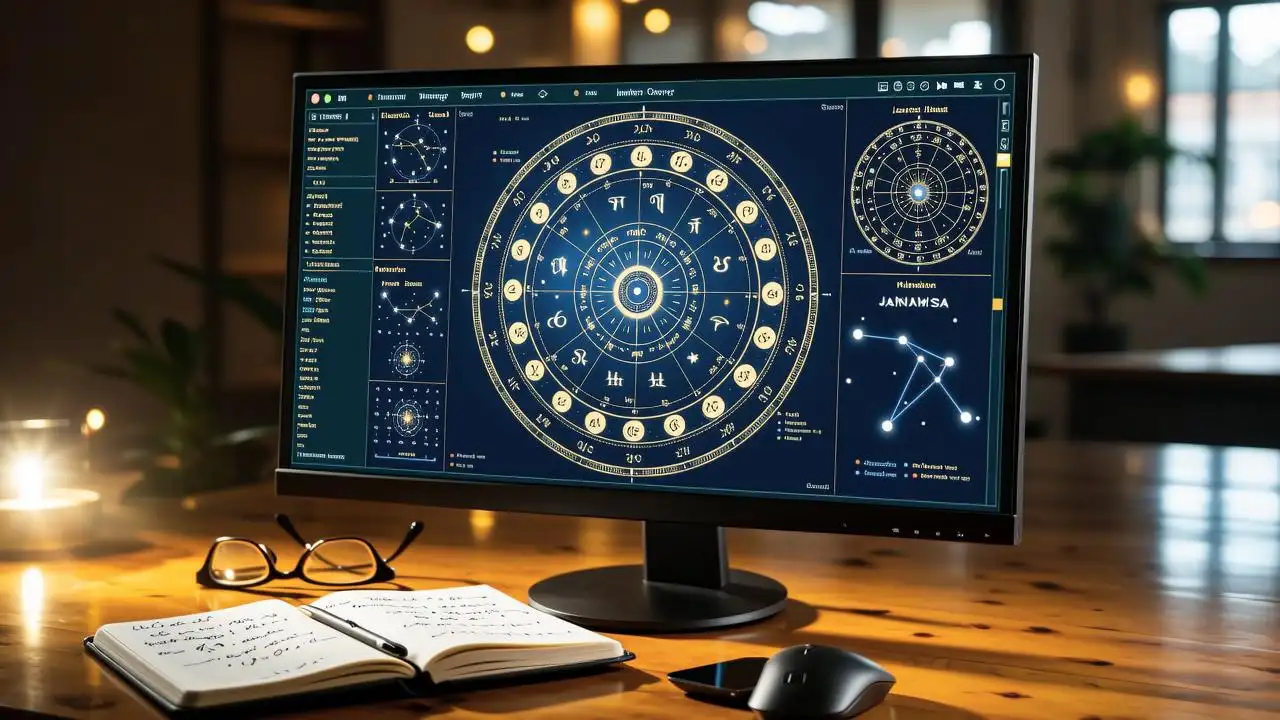
While online tools make it easy to generate a Vedic astrology birth chart, accurate interpretation demands training, experience, and ethical judgment. Consulting a qualified Vedic astrologer ensures personalized insights free from misinterpretation, especially when dealing with complex yogas or challenging dasha periods. Moreover, studying classical texts like the *Brihat Parashara Hora Shastra* enables deeper engagement with the philosophical and technical dimensions of the system.
Ultimately, the vedic astrology chart is not a deterministic script but a mirror reflecting tendencies and opportunities. When approached with discernment, it becomes a powerful tool for self-awareness, growth, and conscious living—helping individuals align with their dharma and navigate life’s journey with greater clarity and resilience.
【Disclaimer】The content related to Astrology in this article is intended for informational purposes only and does not constitute professional advice in any field. Readers are encouraged to make decisions based on their own judgment and, when necessary, consult qualified experts. The author and publisher assume no liability for any actions taken based on the information provided herein.
Arjun Mehta
|
2025.12.17


